Different Types of Predictive Models:
-
A key aim of machine learning is to build predictive models1 from data.
-
For statistical models, we assume a particular functional relationship between two or more variables (such as a straight line relating two variables in simple linear regression).
- Example: Explaining the relationship between study hours and test scores.
-
In mechanistic models, we develop a model for a process that enables us to relate different variables to each other. These process-based models often involve a simulation based upon rules of physics, chemistry, economics, or some other domain.
- Example: Modeling how a virus spreads through a population using infection and recovery rates.
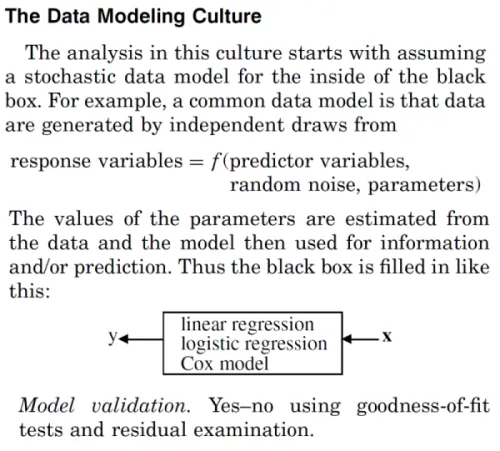
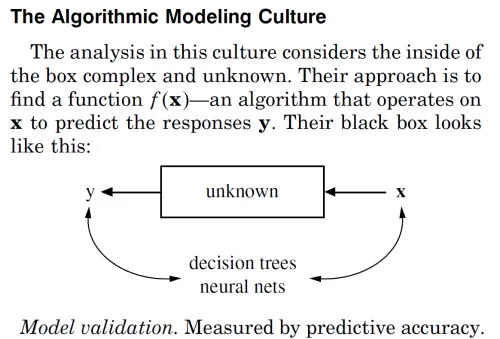
- Machine learning models introduce a more algorithmic approach driven by data, without assuming a particular form for the relationships among variables. ML models are often black boxes, able to make predictions after being trained, but with little insight to how those predictions are made.
- Example: Determine whether an incoming email is spam or not through classification.
Introduction to Machine Learning:
- ML aims to automate the processes of pattern discovery and statistical modeling of data.
- Supervised Learning: Works with a set of labeled examples to begin with. There are two broad sub types of problems:
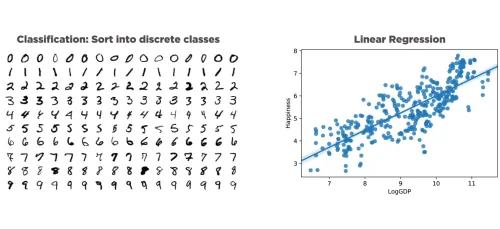
- Classification: Predicting a categorical label (e.g., spam or not spam).
- Regression: Predicting a numerical value (e.g., price of a house).
- Unsupervised Learning: Only the data themselves are provided. Examples include:
- Feature extraction: Finding a smaller set of features that can be used to represent the data and capture semantic meaning.
- Clustering: Grouping similar data points together (e.g., customer segmentation).
Strategy For Evaluating Supervised Learning Models:
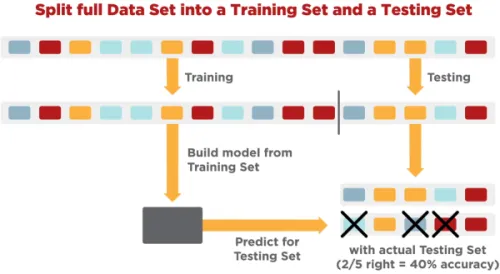
- Train-test split: Split the data into a training set and a test set. The training set is used to train the model, while the test set is used to evaluate its performance.
Footnotes
-
Breiman, Leo. Statistical modeling: The two cultures. Statistical science 16.3 (2001): 199-231. ↩